
Key Equipment: Vacuum Emulsifier / (Jacketed) Mixing Tank
This document describes the process flow and equipment configuration of the pressed powder (color cosmetics) production line, focusing on the line layout built around the core mixing equipment — the Vacuum Emulsifier / (Jacketed) Mixing Tank.
Pressed powder cosmetics are compressed powder beauty products (such as pressed powders and face powder compacts) made mainly from powder raw materials (talc, mica powder, color pigments etc.) together with binders, oils and other functional additives through mixing, grinding and press molding. The core process is to fully and uniformly mix the powders with binders and other components in the jacketed equipment, then refine by grinding and press into shape. The mixing, grinding and press molding steps directly determine the fineness, color uniformity and molding quality of the pressed powder, and are the key links of the whole production line.
By material flow, the pressed powder (color cosmetics) production line is divided into four functional zones — pretreatment, mixing, molding, and packaging — organized around the core mixing equipment (Vacuum Emulsifier / (Jacketed) Mixing Tank):
| Functional Zone | Main Processes | Main Equipment | Function |
|---|---|---|---|
| Pretreatment zone | Raw material inspection, weighing & batching | Electronic scales, batching containers, sieving device | Inspect and weigh raw materials such as powders, pigments and binders |
| Mixing zone (core) | Mixing & blending, homogenization, defoaming | Vacuum Emulsifier / (Jacketed) Mixing Tank | Fully mix, homogenize and degas the powders, binders and other components in the jacketed mixing tank |
| Molding zone | Grinding, press molding, inspection | Grinder/pulverizer, pressing & molding machine, inspection equipment | Refine the powders by grinding, press into compacts and complete inspection |
| Packaging zone | Packaging, finished product inspection | Packaging machine, coding equipment | Package and label; inspect finished products before warehousing |
Materials flow sequentially from the pretreatment zone into the mixing zone, molding zone and packaging zone, forming a continuous, closed and traceable production flow.
The typical process flow of pressed powder (color cosmetics) is: raw material inspection → weighing & batching → mixing & blending (vacuum emulsifier/mixing tank) → grinding → press molding → inspection → packaging → finished product inspection & warehousing. Each step is described as follows:
| No. | Process Step | Step Description | Key Control |
|---|---|---|---|
| 1 | Raw material inspection | Inspect raw materials such as powders, pigments and binders; store them for later use after they pass | — |
| 2 | Weighing & batching | Accurately weigh powders, pigments, binders, oils and other raw materials according to the formula | Accurate proportioning |
| 3 | Mixing & blending | Charge the powders and binders into the vacuum emulsifier/mixing tank; mix, homogenize and vacuum-degas thoroughly | Mixing ★ (core) |
| 4 | Grinding | Refine the mixed material through the grinder/pulverizer so that the powder particle size is uniform | Grinding ★ |
| 5 | Press molding | Fill the ground powder into molds and press into compacts | Press molding ★ |
| 6 | Inspection | Inspect the molded compacts on appearance, color, strength etc. | Pass/fail judgment |
| 7 | Packaging | Package and label; inspect finished products before warehousing | Labeling integrity |
Note: The steps marked with ★ in the table (grinding and press molding) are key process control points, among which mixing is the core control link of the whole production process.
The Vacuum Emulsifier / (Jacketed) Mixing Tank is the core equipment of the pressed powder (color cosmetics) production line. Its main body is a mixing tank with a heating/cooling jacket, integrated with a vacuum system, a homogenizing device and a wall-scraping stirring device, combining heating, mixing, homogenization, defoaming and other functions in one unit, ensuring the powders, binders and other components are fully and uniformly mixed.
| Item | Description |
|---|---|
| Function | Heating & mixing of powders, binders and other components, homogenization and vacuum defoaming — the key process that ensures uniform powder blending |
| Main structure | Mixing tank with a heating/cooling jacket; steam or heat-transfer medium circulates in the jacket for temperature control |
| Stirring system | A central paddle works with a wall-scraping paddle to ensure thorough mixing of the powder material and prevent wall sticking |
| Homogenizing system | A high-speed homogenizing device achieves micro-level uniform dispersion of powders and binders |
| Vacuum system | The tank is evacuated to remove air and reduce oxidation, improving powder uniformity |
| Temperature control | Heating through the jacket, combined with temperature sensors for precise mixing temperature control |
| Advantages | Closed operation, uniform mixing, dust-free and hygienic, good powder dispersion, easy cleaning (CIP) |
In the production line, the Vacuum Emulsifier / (Jacketed) Mixing Tank receives the powders and binders from weighing & batching and completes thorough mixing under heating, vacuum and homogenization, producing a uniform powder blend, which then passes through grinding and press molding into the subsequent packaging processes.
Step 4 · Grinding
Refine the mixed material through the grinder/pulverizer so that the powder particle size is uniform
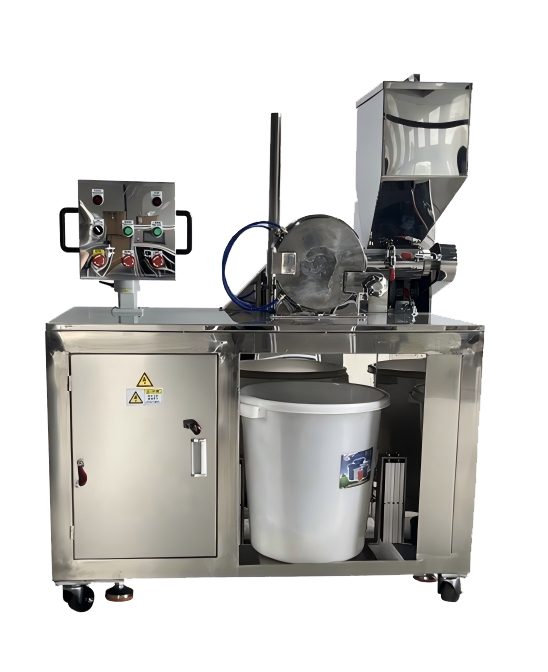
Ultrafine Pulverizer
Step 5 · Press molding
Fill the ground powder into molds and press into compacts
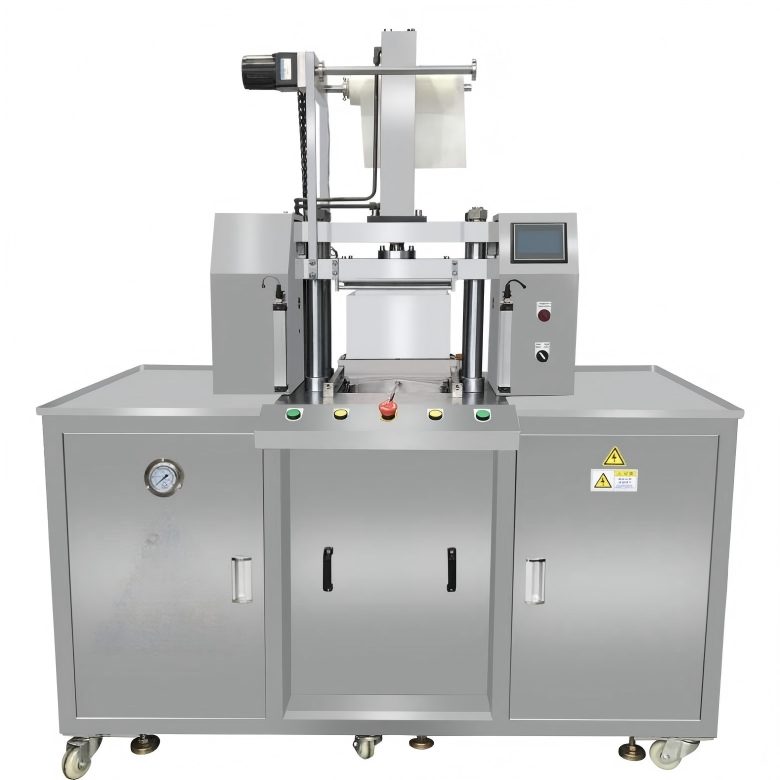
Automatic Powder Filling & Pressing Machine
Step 7 · Packaging
Package and label; inspect finished products before warehousing
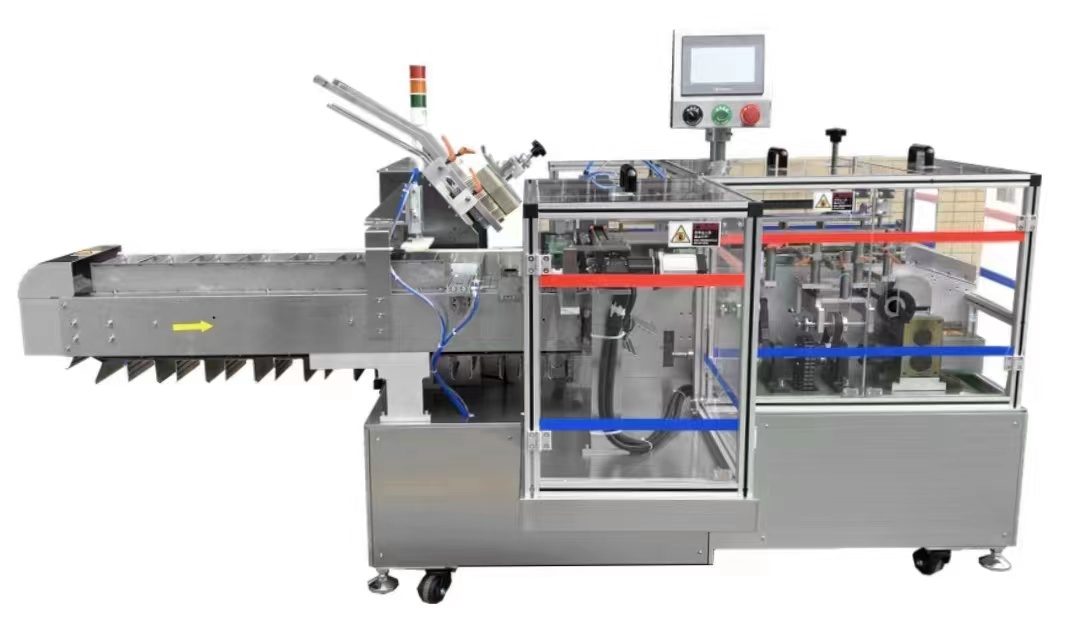
Cartoning Machine
Core EquipmentCore Equipment
Heating & mixing of powders, binders and other components, homogenization and vacuum defoaming — the key process that ensures uniform powder blending
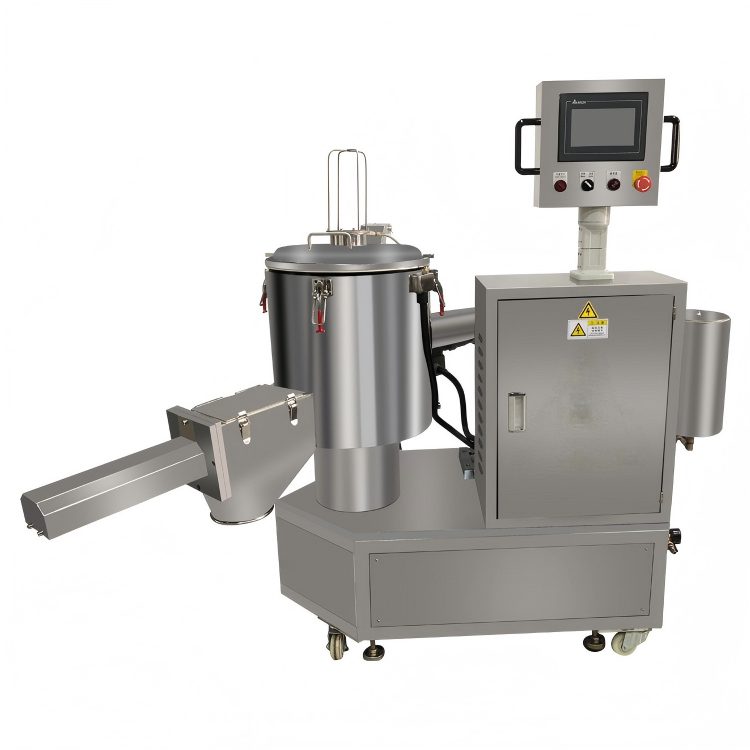
Powder Mixing Machine
Finished Products
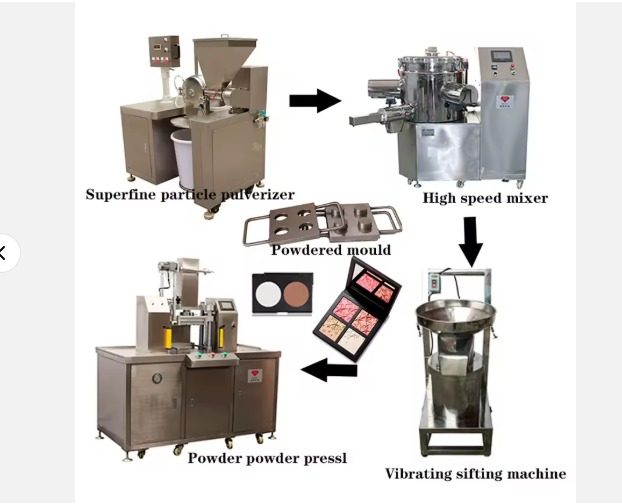
Pressed Powder (Finished Product)
Supporting Equipment
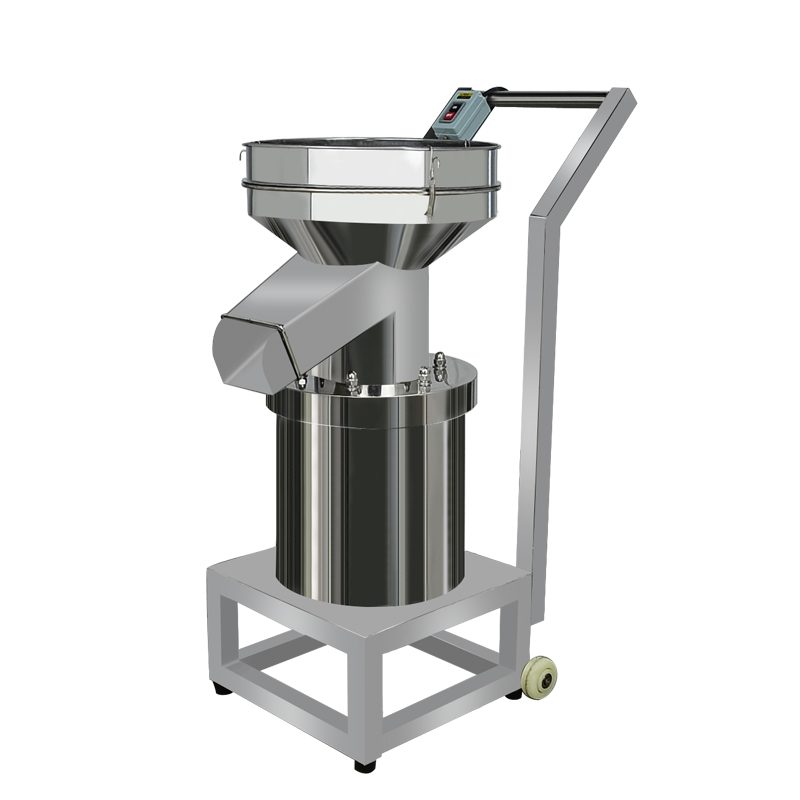
Vibrating Sieve Machine
The figure below shows the production process flow of pressed powder (color cosmetics). The core equipment highlighted in orange, the “Vacuum Emulsifier / (Jacketed) Mixing Tank”, sits at the mixing & blending step after weighing & batching, and is the key equipment of the whole line; the two key control points “grinding” and “press molding” are also marked.
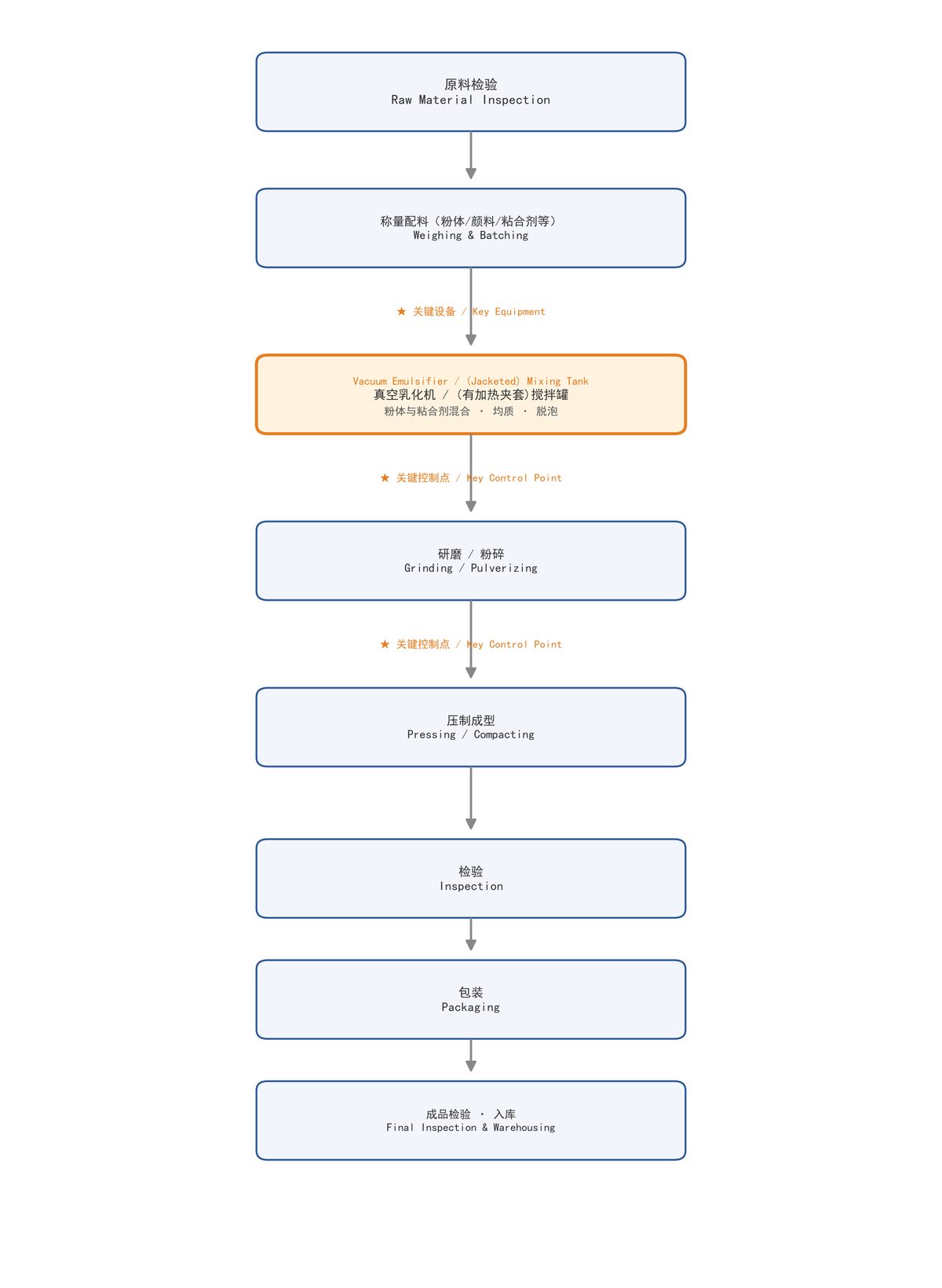
Figure: Process flow of pressed powder (color cosmetics) (★ key equipment: Vacuum Emulsifier / (Jacketed) Mixing Tank; labeled in both Chinese and English)


