
RO Water Treatment System, one stage
Featuring custom capacity (500-10,000L/H), this one stage ro water treatment system offers reliable purification for pharmaceutical and food production lines.
View product
This page compares the pilot builds of the PMK-A hydraulic lifting vacuum emulsifying machine — the 50 L and the 100 L — and then walks through the configurator choices that decide how the unit runs day to day. Instead of restating one product sheet, it puts capacity, motor power, total installed power, tank wall thickness and phase-pot sizing into a single table, then turns each number into a buying decision. If you are sourcing an emulsifying machine for creams, lotions, ointments or other paste-like products, the sections below show where 50 L stops being enough, which options are worth adding at pilot stage, and which six data points get you an accurate quote.
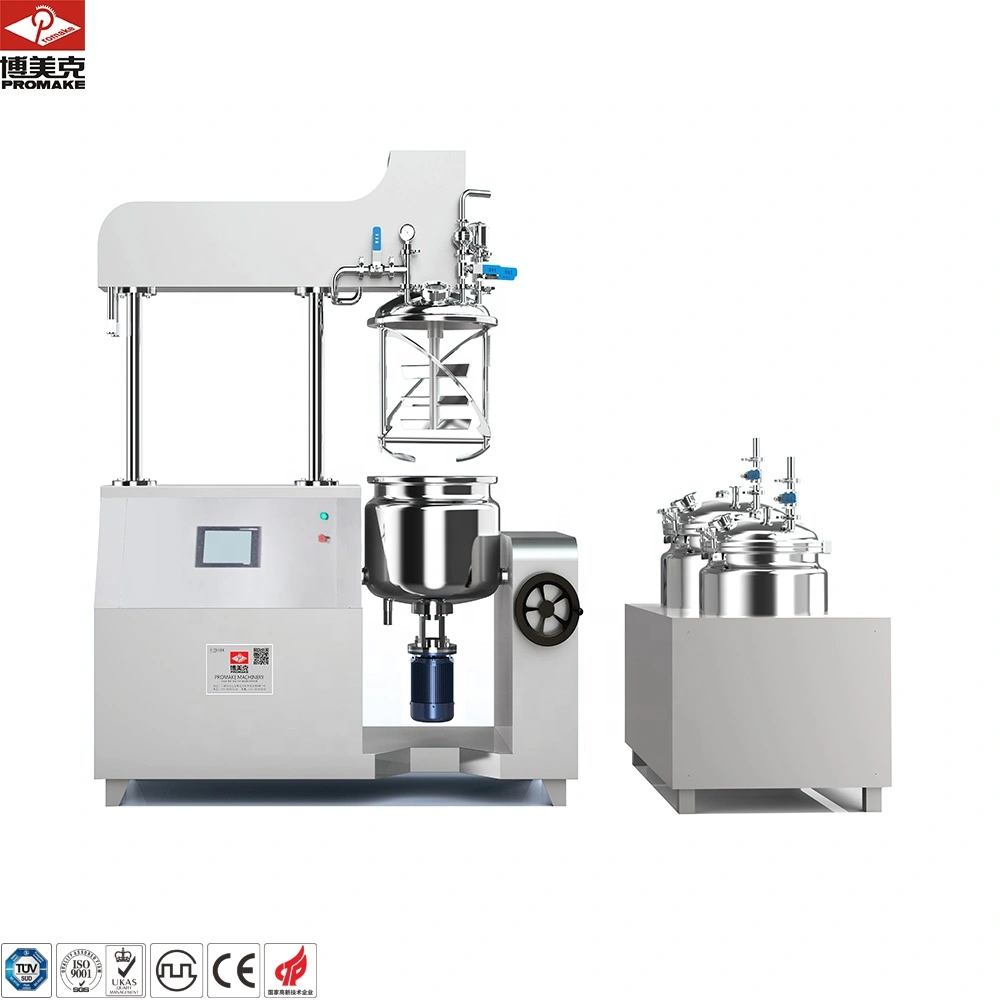

Before you compare numbers, decide whether the machine's operating features match how your team works. Each item below is stated on the product page and each one changes a real maintenance, quality or cleaning task.
The two pilot models share the same option set and the same 4/3/3 mm printed wall thickness. What separates them is volume, drive power and phase-pot capacity — so the last column is the one to read first.
| Model | Main tank effective volume | Main motor | RS motor | HM (homogenizer) motor | HL pump | Total power | Main tank wall thickness | Oil phase pot | Aqueous phase pot | Choose this if… |
|---|---|---|---|---|---|---|---|---|---|---|
| PMK-50L | 50 L | 0.75 kW / 0–63 rpm | 0.37 kW / 0–63 rpm | 2.2 kW | 0.75 kW | 18 kW | 4/3/3 mm | 20 L | 40 L | You are screening formulations and running small trial batches, want the lower 18 kW site load, and need to change options often between projects. |
| PMK-100L | 100 L | 1.5 kW / 0–63 rpm | 0.55 kW / 0–63 rpm | 4 kW | 1.1 kW | 31 kW | 4/3/3 mm | 40 L | 80 L | You need to double the working batch without changing the rest of the configuration, and your electrical supply can carry the 31 kW total. |
On a narrow screen, drag the table sideways to see the remaining columns. Every figure above is printed on the PMK-A 50L/100L equipment detail table.
The table lists 50 L and 100 L as effective working volumes. Size your formulation to the working volume, not to the vessel's outer size, and confirm the usable volume at quotation.
18 kW and 31 kW are totals across main, RS, homogenizer and pump drives. Ask your electrical engineer whether the supply can take the total before you confirm a model.
The specification is printed as 4/3/3 mm without naming which vessel each figure refers to. Ask the supplier to identify the part behind each number if wall thickness matters to your process.
Oil and aqueous phases are prepared in separate pots sized 20 L / 40 L on the 50 L build and 40 L / 80 L on the 100 L build. Check that this split matches your formulation ratios.
Find the situation closest to your project, then use the specification and options listed with it as the starting point for your enquiry.
Specification to start from: PMK-50L, 50 L effective volume, 0.75 kW main motor and 2.2 kW homogenizer motor, 18 kW total.
Options to consider: electric heating jacket, manual or semi-automatic button-panel control, casters for moving the unit between benches.
The decision you are making: whether the smallest working volume lets you trial a full batch without committing to production utilities.
Specification to start from: PMK-100L, 100 L effective volume, 1.5 kW main motor and 4 kW homogenizer motor, 31 kW total.
Options to consider: PLC + touchscreen, steam jacket if plant steam exists, fixed bracket with weighing system and adjustable levelling feet.
The decision you are making: whether doubling the batch now avoids re-validating the recipe on a larger machine later.
Specification to start from: the platform is stated to handle viscous materials and paste-like products; compare homogenizer motors — 2.2 kW on the 50 L and 4 kW on the 100 L.
Options to consider: heating jacket for viscosity control, full external cover plates for cleanliness around sticky fills.
The decision you are making: whether the homogenizer rating and total power suit your product's resistance to mixing, not just its batch size.
Specification to start from: the page states GMP hygienic standards and GMP compliance, with pharmaceutical and cosmetic listed among target industries.
Options to consider: complete external cover plates, explosion-proof control box and explosion-proof wiring where solvents are present, remote monitoring or networked control for records.
The decision you are making: which control and guarding level your quality system requires — confirm any documentation you need in writing before ordering.
Specification to start from: base configuration AC 380V/50Hz three-phase five-wire, with 60 Hz and other voltages offered as options.
Options to consider: 480V/208V 60Hz or 415V 50Hz supply, plus the wiring configuration — TN-S 3-phase 4-wire or TN-C-S 3-phase 5-wire.
The decision you are making: fixing the supply specification before the machine is built, rather than adapting it on site.
Specification to start from: the page states OEM/ODM and batch manufacturing are supported, with adjustable tank volume and customizable controls.
Options to consider: the control and base combinations that best match your filling and record-keeping routine.
The decision you are making: which parts of the build you standardize across a range of client formulations, and which you keep flexible.
Two questions decide whether this platform belongs in your plant: what the build is stated to comply with, and how the phase preparation is arranged.

Pricing on this machine is configuration-based — the enquiry flow on the product page works through options and a quantity selector rather than a fixed price. If your first message includes the six points below, the reply can be a real quotation instead of a follow-up question.
Keep adjacent product options together for a faster catalog comparison.
Featuring custom capacity (500-10,000L/H), this one stage ro water treatment system offers reliable purification for pharmaceutical and food production lines.
View product
Engineered with stainless steel, this two stage ro water treatment system provides 500-10,000 L/H capacity. A leading reverse osmosis water purification system factory solution for industrial purity…
View product
Fully customizable OEM solutions for high-grade stainless steel storage tanks. Reliable units from expert chemical storage tanks manufacturers for industrial use.
View productthey share the same 4/3/3 mm printed main tank wall thickness and the same option set. the differences are effective volume (50 l vs 100 l), main motor (0.75 kw vs 1.5 kw), rs motor (0.37 kw vs 0.55 kw), homogenizer motor (2.2 kw vs 4 kw), hl pump (0.75 kw vs 1.1 kw), total power (18 kw vs 31 kw) and phase pots (20 l / 40 l vs 40 l / 80 l).
the base configuration is ac 380v/50hz, three-phase five-wire. options include 400v/230v 50hz, 480v/208v 60hz, 380v/200v 50hz, 380v/200v 60hz and 415v 50hz three-phase supplies, plus 220v 50hz and 110v 50hz single-phase options. wiring configurations listed are tn-s 3-phase 4-wire, tn-c-s 3-phase 5-wire and 1-phase 3-wire.
the configurator offers no jacket layer with no heating, a heating jacket with electric heater, or a heating jacket with steam. choose steam when a plant steam supply is already available; choose the electric heater when the machine must be self-contained.
the product page states a homogenization particle size down to 1 μm, and describes vacuum defoaming as reducing air bubbles to improve emulsion quality. confirm the figure against your own droplet-size target when you request a quote.
options run from manual, through semi-automatic electric or pneumatic drive with a button panel, to automatic pneumatic drive and automatic plc with touchscreen. additional options include an explosion-proof control box with explosion-proof wiring, a remote monitoring interface, and an intelligent control networking function.
the page lists creams, lotions, ointments and other paste-like products, including viscous materials, and names pharmaceutical, cosmetic, food and chemical as target industries. it states gmp hygienic standards and gmp compliance, and states that oem/odm and batch manufacturing are supported. request any specific compliance documents you need in writing with your enquiry.


